Literary mobility · Published and updated
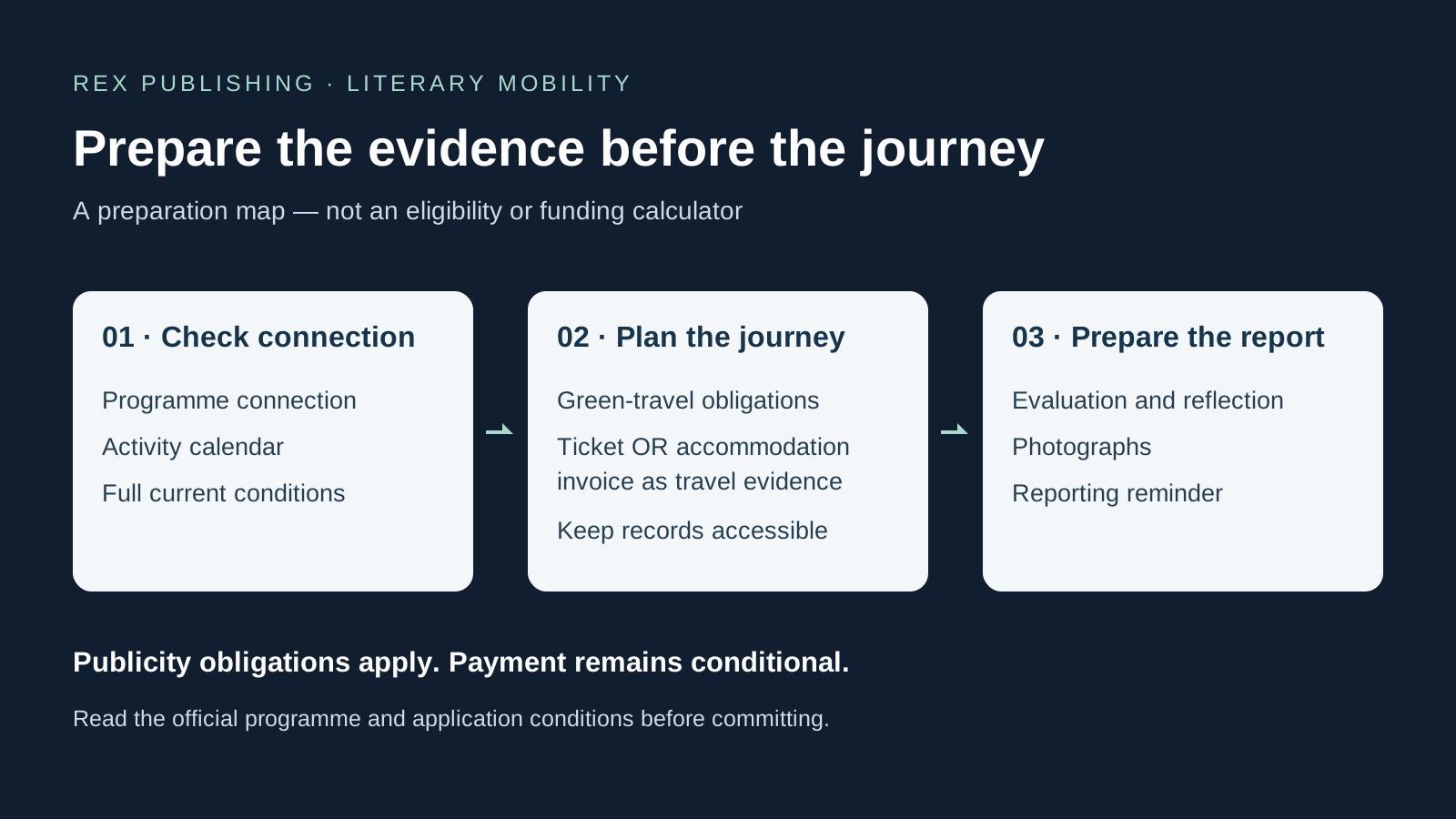
A literary trip can leave you with useful conversations and a surprisingly difficult reporting file. For writers, translators and literary professionals considering CELA fwd mobility support, the practical preparation is to understand what must happen after the journey—before making travel commitments.
This is an attributed preparation guide, not a complete eligibility assessment, grant-budget calculator or tested application walkthrough. Read the official mobility section and current application introduction and conditions before committing money or travel. This guide does not determine an award amount or resolve distance-band questions.
Start with your programme connection and activity dates
The programme page names fwd literary artists and professionals, and emerging writers, translators and literary professionals involved in CELA cycles before 2026. It is not a general travel grant for anyone working with books. Check your connection against the current terms rather than assuming that a relevant occupation is sufficient.
As checked November 5, the programme lists November 30, 2026 as the closing date for this mobility call. The public form introduction specifies activities from January 1 to June 30, 2027. The stated purposes include literary events, professional-development opportunities and book fairs abroad. Those dates do not establish remaining funds, an exact cutoff hour or approval of your chosen trip. Programme calendar; activity dates in the public introduction.
Our preparation suggestion: keep the event description, dates and your reason for attending in one working note. That is a planning aid, not a verified application-field requirement.
Approval is not the same as payment
The public introduction makes payment conditional on an approved grant, a signed agreement with fwd represented by Wintertuin, and an online report. It does not establish an advance you can spend when applying.
Before booking, decide how you would cover costs without assuming grant cash has arrived. Keep application, decision, agreement and payment as separate entries in your planning record. This is Rex’s cash-planning advice, not a statement about an individual award or payment date.
Prepare for the report while the journey is happening
The introduction requires reporting no later than 30 days after the event or journey. It calls for evaluation and reflection, photographs, and a flight, bus or train ticket or an accommodation invoice confirming that the journey took place. Preserve that distinction: the published wording does not demand every ticket and every accommodation invoice together. Read the reporting conditions.
A useful personal record has three parts:
- Evidence of travel: retain the applicable ticket or accommodation invoice in a place you can find after returning.
- Material for reflection: make brief notes about the activity while the details are fresh, and plan how to retain suitable photographs.
- A reporting reminder: put the required reporting window in your calendar before departure, rather than relying on memory afterwards.
These are editorial organization suggestions. We have not inspected an online report template or the detailed application steps; this is not an upload checklist. Keep personal travel records private rather than turning them into promotional illustrations.
Publicity and green travel are obligations, not extras
The form introduction requires tagging fwd on LinkedIn and/or Instagram in posts about the activities, and using its logo on websites mentioning the event or journey. Applying also consents to publication of information about the planned event and the support allocated. Consider those requirements before submitting, especially if another organization manages your event page or communications.
It also requires green travel. The terms describe low-emission transport for most of a journey and wider measures to reduce environmental impact. Read the full wording when planning transport and accommodation; this short guide is not a substitute for those conditions or a distance calculation.
Make one pre-trip decision
Before committing, ask: can you meet the travel, publicity and reporting conditions, retain the required evidence, and cover the trip without treating an application as cash? If an answer is unclear, resolve it against the current terms before proceeding.
This article excludes publisher grants, catalogue titles, publication-year rules, organizer support and award calculations. Programme information and application conditions are separate procedural evidence from the same operator, not independent corroboration. No application was started or submitted for this guide.
For the separate issue of contracts, see our translation-contract baseline. For careful document circulation, use the manuscript-recipient checklist. Learn about Rex Publishing or visit our contact page for translation-project enquiries.
Sources checked November 5, 2026. Planning suggestions and the preparation map are Rex Publishing’s editorial work, not additional programme requirements.