Rights workflow · Published and updated
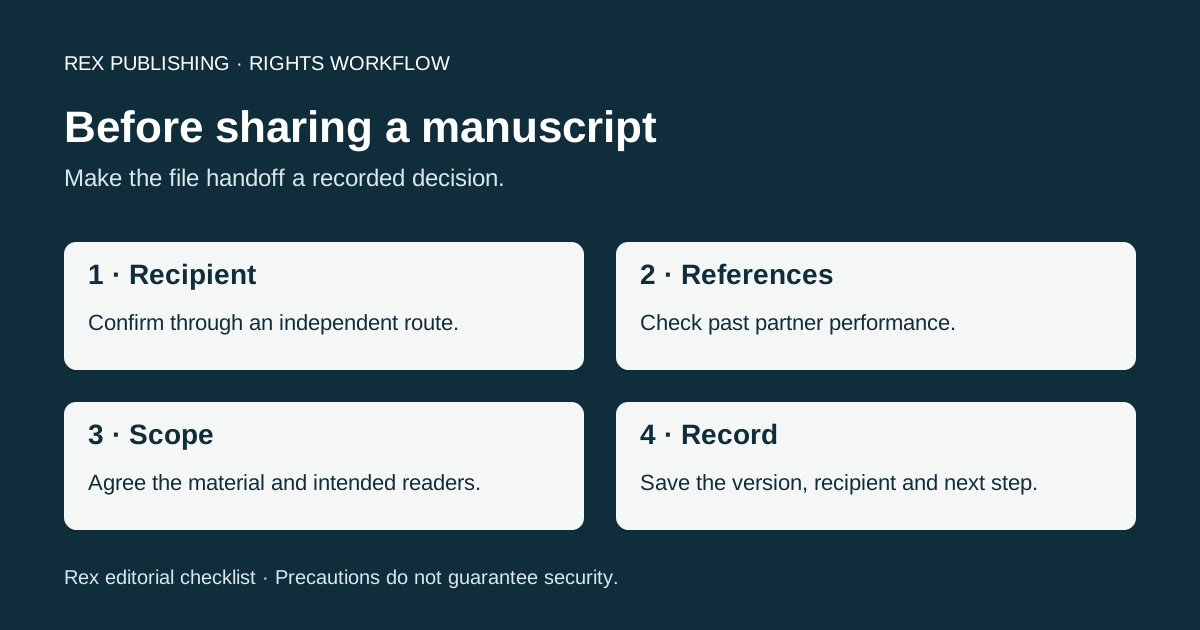
An interested rights buyer asks for your manuscript. Before attaching it, answer four questions: who will receive it, what their previous partners can confirm, what you have agreed to share and how you will record the handoff. Interest in a book is a reason to continue a conversation, not a reason to skip those checks.
The Book Industry Study Group’s Rights FAQ supports sending digital manuscripts to interested publishers when you know they are legitimate businesses. It recommends watermarking digital material, checking representatives, securing files and obtaining protective agreements. Separately, the Authors Guild’s publishing alerts caution authors about unsolicited messages and lookalike email and website domains.
Those recommendations address different questions: whether a prospective partner is credible, and whether the person contacting you is actually that partner. The workflow below connects them. Its handoff record is Rex editorial guidance, not an official form or a guarantee of security.
1. Confirm the intended recipient independently
Start with the person and organization, not the attachment request. The Authors Guild advises checking identities and credentials before sharing work and verifying doubtful communications directly. Its September 11, 2026 meeting-link warning also cautions against addresses and URLs made to resemble authentic domains.
For a manuscript request, our suggested check is to find the organization’s contact details independently of the incoming message and confirm the person’s role and request through that route. Record the address you confirmed, rather than relying only on the displayed sender name. If an existing contact asks you to use a different address, confirm the change through the channel you already know.
Keep an unresolved check separate from an accusation. A missing confirmation means you have something to clarify before sending; it does not establish wrongdoing.
2. Ask what previous partners can verify
A real organization and a confirmed employee do not answer the performance question. BISG recommends reviewing a prospective translation publisher’s website and requesting its translated-title history. Where possible, contact the original publisher or agent to check whether agreements and advances were handled promptly and required copies and royalty statements were supplied.
Use that advice to ask specific questions about a previous rights relationship. “Would you work with them again?” may open the conversation, but it does not replace asking about payment, reporting and follow-through. Keep your reference notes private; this is a decision aid, not a public ranking of publishers.
If references are unavailable or responses are incomplete, note the gap. Do not turn silence into a positive reference. Our suggestion is to resolve what matters to your proposed handoff before deciding whether to share more material.
3. Agree what the recipient needs now
Once recipient and partner checks are satisfactory, make the immediate request precise. As a Rex preparation step, ask whether the current conversation needs a synopsis, sample chapters or the full manuscript, who will review it and whether anyone else is expected to receive it. Confirm the chosen version and the purpose of sharing in writing.
BISG’s file precautions are useful here, but a watermark is a precaution, not proof that disclosure cannot happen. Select file handling and any protective agreement appropriate to the discussion; do not treat this checklist as a ready-made contract. If the proposed agreement or sharing permissions are unclear, get appropriate professional review rather than inventing clauses from a blog article.
This guide concerns a file handoff, not the full ownership or licensing analysis. For that earlier preparation, see our translation-rights checklist for authors. A verified recipient does not resolve uncertainty about which rights you control.
4. Keep a short handoff record
Use the following Rex-suggested record alongside your correspondence. It lets a colleague see what was checked and what was actually sent without reconstructing the whole email thread.
| Check | What to record |
|---|---|
| Recipient | Confirmed person, role and address; independent confirmation route and date |
| References | Who responded, which performance questions were answered and any remaining gaps |
| Sharing scope | Material requested, intended readers, purpose and agreed handling |
| File and next step | Exact version, sending date, person responsible for follow-up and agreed next action |
For example, a record might say that the recipient was independently confirmed, one reference remains unanswered and no file has yet been sent. That is a useful status, not an administrative failure. Keep the unresolved point visible instead of filling the field with an assumption.
If you do send material, record the actual file version and address used. A later request for a revised manuscript or wider circulation should become a new decision, not an invisible extension of the first handoff.
Make the next action explicit
Before sending, complete the recipient check, note the reference evidence, agree the immediate sharing scope and assign the follow-up. If a material question remains open, ask it without attaching the manuscript. That keeps the conversation moving while making the decision to release a file deliberate and traceable.
Sources checked October 21, 2026. This is a preparation workflow, not a tested security service, a legal clearance or a promise that checks eliminate risk.