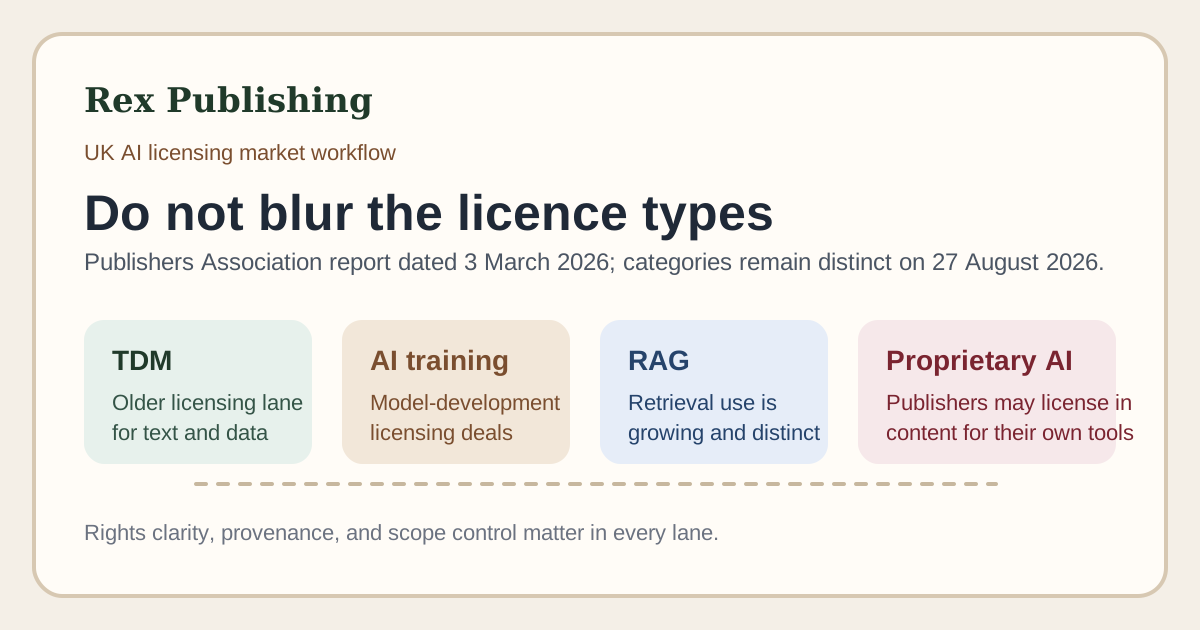
As of Thursday, August 27, 2026, the useful thing about the Publishers Association's March 3, 2026 publication page is not its rhetoric about national advantage. It is the narrower operational claim underneath: UK publishers are already licensing content for text and data mining, AI training, and retrieval-augmented generation, while some are also licensing in other publishers' material for proprietary AI products and services.
That matters because too many publishing conversations still flatten all AI use into one foggy debate. The Publishers Association is describing a market with different transaction types, different risk profiles, and different rights questions. For authors, agents, translators, and publishing teams, that distinction is much more useful than a generic argument about whether AI is good or bad for culture.
The report says AI licensing is already a market, not a future possibility
The Publishers Association says its report is the first comprehensive account of how books and journal publishers license content for AI use. Its publication page says publishers have licensed content for TDM for a decade, that AI training deals were in place by 2023, and that licensing for RAG is now a meaningful and growing part of the market.
The report PDF adds an important limit that readers should keep in view. It says the findings are based on a survey and interviews with Publishers Association members and account for the majority of the UK industry. That makes this a strong primary market document for the UK. It does not make it a full global census, and it does not prove that every rightsholder has equal bargaining power inside these deal structures.
Even so, the basic point is hard to ignore. If publishers have been licensing for TDM for years, if training licences were already being agreed by 2023, and if RAG is now material enough to be singled out, then AI licensing can no longer be treated as purely speculative. It is already part of the rights terrain.
The category split is the real practical value
The report's strongest operational contribution is the way it separates different uses. TDM is not the same thing as full model training. Training is not the same thing as retrieval-driven product behaviour. And licensing in content for a publisher's own AI product is not the same transaction as licensing content out to an external AI developer.
That may sound obvious, but it is exactly where many rights conversations break down. A contract team, an author, and a metadata manager can all say "AI use" while meaning different things. The report helps force a cleaner vocabulary.
- TDM points to a more established licensing lane with a longer commercial history.
- AI training raises harder questions about scale, reuse, and the long-term value extracted from licensed content.
- RAG suggests a newer market where current retrieval behaviour and content quality may matter more directly than one-off corpus ingestion alone.
- Proprietary AI products and services introduce a separate workflow where publishers may act as buyers as well as sellers.
That split is what makes the report useful for Rex readers. It turns a loud policy topic into a workflow question: which exact use is being licensed, by whom, for what product logic, with what evidence of authority and control?
The expected 2026 expansion is meaningful, but it is still uneven
The Publishers Association says the number of publishers active in the AI licensing market is expected to almost double by the end of 2026. The executive summary also says all major academic publishers in the UK are expected to be active by then.
Readers should use that carefully. It is fair to say the market is expanding. It is not fair to pretend that expansion is evenly distributed across trade houses, small presses, academic publishers, educational publishers, author-owned rights businesses, and individual translators. The report itself gives the strongest signal around the major publisher end of the market, especially where high-volume, high-value, highly structured content is already commercially legible to AI buyers.
That is why smaller rights holders should read the report as a directional signal, not as reassurance that the playing field is already balanced. A growing market can still be asymmetric. In fact, it usually is.
Transparency remains a workflow problem, not just a political talking point
The report argues that lack of transparency about unlicensed training data makes it harder for publishers to enforce rights and assess licensing requirements. That is a policy position from a trade body, and it should be read as such. But it is also a practical operations problem.
If a rightsholder cannot tell what content was used, in what context, and under what authority, then pricing, enforcement, exclusions, and audit logic all become much weaker. That problem exists even before anyone reaches the larger political fight about copyright exceptions. The workflow issue comes first: poor provenance makes clean licensing harder.
For rights teams, that means documentation still matters. Clear ownership, contract scope, territory logic, format boundaries, and permissions hygiene do not become less important in an AI market. They become more operational because the buyer may be evaluating not only the content itself, but also whether the chain of rights is usable without hidden contamination.
What authors and rights teams should do with this now
- Stop saying "AI licensing" as if it were one thing. Ask whether the actual use case is TDM, training, RAG, or a publisher-run product.
- Attribute market claims carefully. This report is about the UK market as described by the Publishers Association, not a universal map of publishing.
- Audit the rights chain before the negotiation starts. Ambiguous authority is a commercial weakness, not just a legal nuisance.
- Expect uneven leverage. A market can be established and growing while still favouring larger, more structured rightsholders.
- Treat transparency as practical infrastructure. If provenance is murky, clean licensing and clean enforcement both get harder.
The clean takeaway is narrower than the rhetoric around AI usually allows. The UK's AI licensing market matters because it shows that publishing content is already being bought, sold, and integrated across several distinct AI use categories. But the report only becomes useful when readers keep those categories separate and treat rights clarity as part of the product, not a back-office afterthought.
For related Rex context, see our IFRRO AI licensing guide, our EU transparency-code guide, and our translation contracts baseline guide. If you need help tightening a rights workflow before AI-use negotiations get expensive, contact Rex Publishing.