As of Friday, August 28, 2026, BookNet Canada's late-July five-year snapshot is still most useful as a discipline check, not a victory lap. The market signal is real. The lazy reading of it is not.
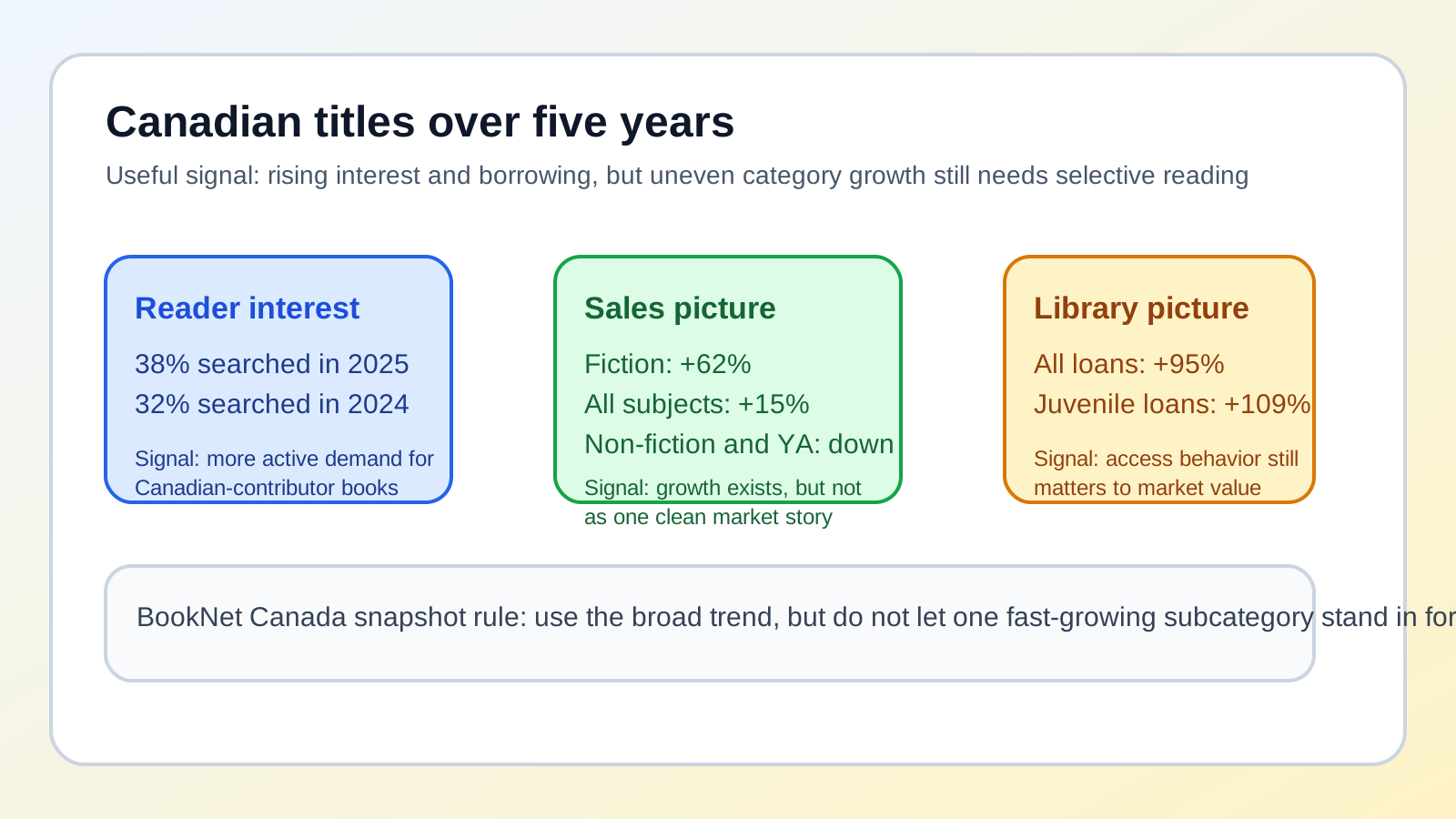
In its July 28, 2026 post on how Canadian titles have been performing over the last five years, BookNet Canada says a title counts as Canadian here when it has a Canadian contributor attached, including an author, illustrator, translator, or editor who is a Canadian citizen or permanent resident. The same post says 38% of Canadian book buyers searched for books by Canadian authors or illustrators in 2025, up from 32% in 2024. It also says fiction sales for Canadian titles rose 62% from the first half of 2022 to the first half of 2026, while all subjects combined rose 15% and both non-fiction and young adult declined over that span.
The borrowing side matters just as much. BookNet says library loans across all subjects combined rose 95% from 2022 to 2026, with juvenile loans up 109%. That makes this less a nationalist-demand story than a mixed discovery-and-access story. Canadian-contributor interest is up, but the route from attention to buying, borrowing, and rights value is not one straight line.
The useful signal is broader interest, not every breakout subcategory
BookNet's post gives two layers of evidence that should be kept separate. One layer is broad demand: more Canadian buyers actively searched for books by Canadian authors or illustrators in 2025 than in 2024. The second layer is category performance, where the strongest growth is uneven and sometimes dramatic enough to distort the wider picture if read carelessly.
That distinction belongs in the article because some of the biggest subcategory jumps in BookNet's post are obviously not a clean proxy for the whole market. BookNet itself shows standout pockets such as romance-related subcategories growing far faster than the aggregate. That can be useful for scouts and acquisition teams, but only if they resist turning one hot lane into a universal claim about Canadian publishing demand.
The stable lesson is narrower: interest in Canadian-contributor books appears to be rising, but the market remains segmented enough that title, category, and format judgment still matter.
Library growth means access behavior still shapes the market
The five-year snapshot is stronger because it is not only about sales. BookNet's July 28 post says loans for Canadian titles rose sharply across the same period, especially in juvenile categories. That matters because it stops the piece from collapsing into a retail-only story.
BookNet's separate May 19, 2026 borrowers report helps explain why. It says 24% of surveyed Canadians borrowed a book from the public library in 2025, 83% of book borrowers visited the library at least monthly either in person or online, and 58% of borrowers said they borrowed to save money. That is useful context for rights holders and publishers because it suggests borrowing is not a side behavior. It is part of how readers reach books when price, access, and format all matter.
A market where borrowing remains this active should not be read as weak. It should be read as operationally mixed. Discovery, rights packaging, format availability, and library readiness can all affect whether demand turns into durable value.
Method matters if you want to use the figures honestly
The safest way to use BookNet's data is to keep its scope explicit. The July 28 post is a BookNet Canada snapshot about Canadian-contributor titles, not a full census of every Canadian publishing outcome. The related June 9, 2026 consumer-study announcement says the 2025 survey was fielded in July and December 2025 among 1,979 English-speaking Canadian adults, including 976 book buyers.
That methodology is solid enough to be useful and bounded enough to require restraint. It supports a real market reading. It does not justify lazy claims that all Canadian categories are surging, that search interest automatically converts into export traction, or that one year of buyer behavior settles the acquisition question for every territory.
What publishers and rights teams should do with this now
- Use the Canada signal selectively. Treat the broad rise in interest as a scouting prompt, not as proof that every Canadian title category is expanding.
- Read category spikes with caution. Breakout subcategories can inform acquisitions, but they should not be mistaken for whole-market stability.
- Keep libraries in the planning picture. Borrowing growth means access and library visibility still affect how titles travel through the market.
- Separate domestic attention from export readiness. Search and borrowing data can support a pitch, but they do not replace rights, positioning, and comparable-title judgment.
- Be exact about the scope. This is BookNet Canada's view of Canadian-contributor performance, not a universal publishing census.
For related Rex context, see our BookNet Canada ebook market guide, our Canadian contributor metadata guide, and our AAP 2025 revenue baseline.
The honest takeaway on Friday, August 28, 2026 is that Canadian-contributor titles are showing stronger reader interest and stronger library activity, but the useful business lesson is caution, not hype. The market looks more promising when teams read the broad trend and the category unevenness together.
If you need help turning market signals into a practical acquisition, metadata, or rights plan, contact Rex Publishing.