The cleanest way to read the Association of American Publishers' new annual StatShot report is to resist the urge to turn it into prophecy. It is more useful than that, and also narrower than that.
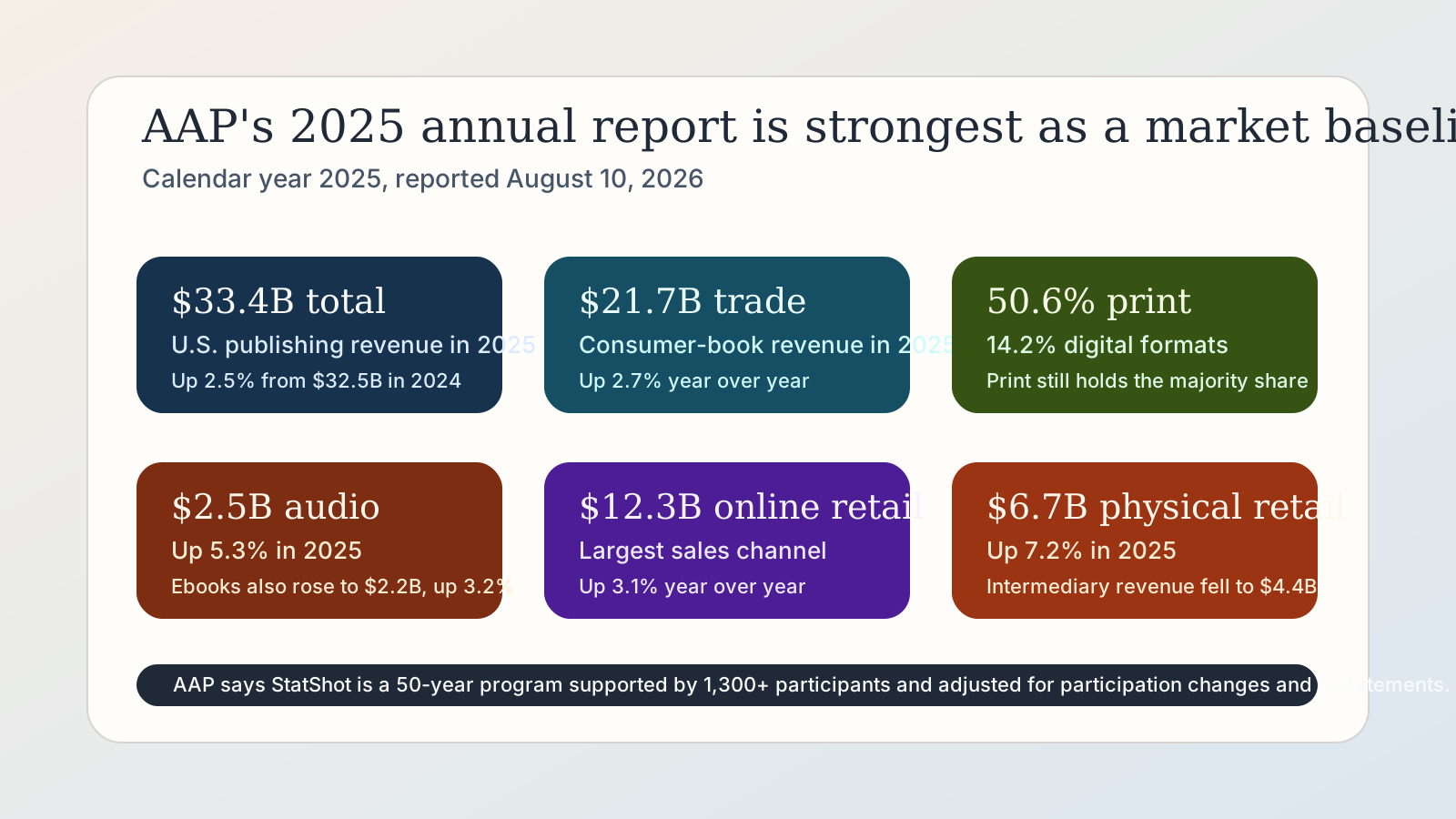
In its August 10, 2026 annual report release for calendar year 2025, AAP says the U.S. publishing industry generated $33.4 billion in aggregate revenue across books and course materials, up 2.5% from $32.5 billion in 2024. AAP also says Trade revenue increased 2.7% to $21.7 billion, print formats still accounted for 50.6% of overall publisher revenue, digital audio rose 5.3% to $2.5 billion, ebooks rose 3.2% to $2.2 billion, and online retail remained the largest channel at $12.3 billion.
For Rex readers, the practical point is straightforward: print is still structurally central, audio is still gaining, ebooks are still commercially material, and channel concentration still matters. That is a planning baseline for rights packaging, format sequencing, adaptation budgets, and sales expectations. It is not a reason to pretend every category will move the same way next quarter.
The 2025 report says the market grew, but not in a way that makes format choices automatic
The headline growth number is real, but the mix matters more than the headline. AAP says overall revenue rose to $33.4 billion in 2025, while print still delivered just over half of all publisher revenue. That alone should cool any lazy "digital took over" storyline.
At the same time, digital formats did keep moving. AAP says digital audio and ebooks together accounted for 14.2% of all revenue in 2025, up 4.3% from 2024. Within Trade, AAP says digital formats accounted for 21.5% of revenue. That is not dominance. It is still meaningful enough that teams making acquisition, distribution, and rights decisions cannot treat digital as an afterthought.
The better reading is that U.S. publishing is still a mixed-format business. Print carries the center of gravity. Audio keeps adding weight. Ebooks keep contributing, but they do not erase the need for title-specific judgment. If a team wants one universal lesson, the report does not offer one.
The channel picture is a reminder that discoverability and distribution still decide a lot
AAP says publisher sales through online retail grew 3.1% year over year and remained the largest channel at $12.3 billion. Physical retail grew faster in percentage terms, up 7.2% to $6.7 billion, while intermediary revenue declined 0.6% to $4.4 billion.
That mix is useful because it pushes publishing teams back toward operational questions. If online retail is still the largest lane by a wide margin, metadata discipline, format availability, pricing clarity, and timing still have outsized influence on what actually gets discovered and sold. If physical retail is still growing meaningfully, print presentation, sell-in timing, and territorial availability still matter too.
The safest takeaway is not that one channel is winning forever. It is that distribution remains concentrated enough that sloppy execution still gets punished. Teams that talk abstractly about demand while neglecting channel readiness are usually skipping the part that decides whether demand can turn into revenue.
Education and professional segments complicate the consumer-book story
The annual report is also a good reminder that the U.S. publishing market is not just Trade. AAP says Higher Education Course Materials increased 8.5% to $4.7 billion, PreK-12 Instructional Materials decreased 2.5% to $5.2 billion, Professional & Scholarly excluding journals declined 1.2% to $1.3 billion, and University Presses increased 4.9% to $368 million.
That matters for authors, rights holders, and small publishing businesses because "the publishing market" is not one monolith. A healthy trade headline can sit beside weaker or stronger conditions elsewhere. Rights strategy, adaptation planning, and market-entry decisions should be built around the segment you are actually entering, not around a broad annual total alone.
The methodology warning belongs in the article, not in the footnotes
AAP's data and statistics page says StatShot has been the gold-standard health report for the U.S. publishing industry for 50 years and is supported by more than 1,300 U.S. publisher and distributor participants. That scale is part of why the report matters.
But AAP's own annual release is careful about method, and Rex readers should be too. The association says the report is the independent work of Industry Insights and is built from publisher-reported data, government statistics, historical AAP research, independent market benchmarks, and other industry research. AAP also says this edition accounts for participation changes and restatements across the five-year period covered.
That does not make the report weak. It makes it usable in the right way. It is a market baseline built from estimation and aggregation, not a flawless census of every publisher and every sale. Readers should trust it enough to inform planning and distrust it enough not to build fake certainty on top of it.
What publishing teams should do with the 2025 baseline
- Keep print central where the business case still supports it. AAP's 2025 mix does not justify treating print as legacy residue.
- Pull audio into planning earlier. Digital audio growth is slower than its 2024 spike, but it is still large enough to belong in acquisition, rights, and adaptation discussions before launch.
- Treat ebook strategy as deliberate, not automatic. Ebook growth is positive, but that does not mean every title should be built around a digital-first assumption.
- Audit channel readiness, not only product readiness. Online retail scale and physical-retail growth both reward cleaner metadata, pricing, timing, and distribution setup.
- Do not mistake an annual report for a forecast model. Use the figures as current baseline context, then layer title, segment, and territory reality on top.
For related Rex context, see our AAP April 2026 format-mix guide, our BookNet Canada ebook market guide, and our UK publishing 2025 export and format-mix guide.
The useful takeaway from AAP's August 10, 2026 annual release is not that the U.S. market suddenly became easy to read. It is that the market still looks mixed, print-heavy, digitally relevant, and channel-dependent. That is enough to improve real publishing decisions if teams use the report as a baseline instead of a slogan.
If you need help turning format, rights, or market signals into a practical publishing plan, contact Rex Publishing.