Translation funding · Published and updated
A translation grant is not money available when the translator signs. For a publisher planning a printed translation with FILI support, the useful task is to connect the application file to the later payment file—and budget the interval between them.
This guide follows that print-edition sequence. It is for authors, translators and rights holders coordinating with the publisher, not a tested application walkthrough or a recommendation of particular books.
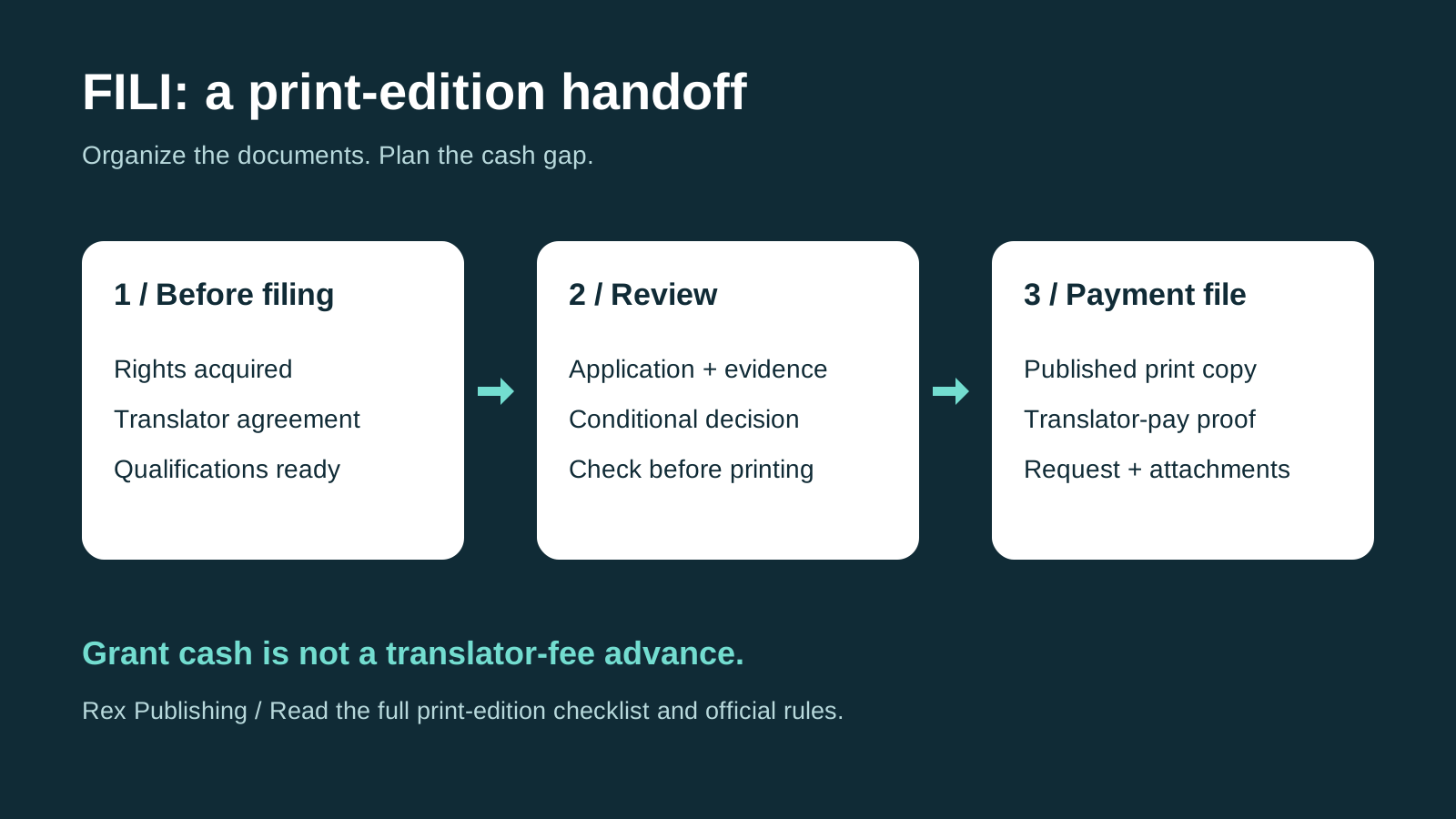
Before filing: put the publisher and documents together
FILI’s foreign-publisher rules require the publisher outside Finland to have acquired translation rights and signed a translator agreement before applying. Eligible originals were published in Finland, in Finnish, Finland-Swedish or Sámi; listed categories include fiction, general nonfiction, children’s books and comics.
The application needs the signed translator agreement and a translator CV or Kääntöpiiri profile. A relevant printing-grant request also needs a printing quote. Printing support is limited to comics, graphic novels and children’s picture books and requires a simultaneous translation-grant application. Other translation funding affects FILI’s award; Creative Europe-funded books are excluded. Check the programme rules.
As checked October 27, the rules give November 1, 2026 as this round’s closing date. No exact cutoff hour is established here. Submit before publication; this date does not establish portal availability or remaining funds.
Assessment is a separate gate
FILI’s evaluation guidance describes advisory-board assessment, not automatic payment for a complete form. Criteria include professional publishing activity, marketing and distribution, and translator skills. Missing attachments, unclear licensing and insufficient funds are among the reasons applications fail.
Our planning recommendation: keep two budget versions, one without support and one reflecting only an actual award. Assign a person to update the production calendar when the decision arrives. A submitted application should not become an assumed receivable in the team’s working cash plan.
Publication and payment need their own file
The recipient instructions require the full contracted translator fee regardless of the grant outcome. Payment evidence includes a bank statement proving translator payment and generally a signed funding agreement, with the stated exception for Nordic Council of Ministers-funded grants.
For this print route, disbursement requires the book to reach the SKS library and a payment request with mandatory attachments in FILI’s system. Check current delivery instructions rather than copying an old address. FILI also says not to print before grant decisions: the book needs the required acknowledgement and logo. Credit the translator in the book and communications. Read the publication and payment requirements.
That sequence makes the practical question: who covers the translator and production bills before grant cash arrives? A possible award does not answer it.
Build one handoff record, not scattered reminders
The table below is Rex’s suggested responsibility record, not a FILI form. The roles are proposals for your team; the underlying requirements are linked above.
| Handoff | Suggested owner | Record to keep together |
|---|---|---|
| Rights and edition | Publisher’s rights lead | Rights agreement, edition language and planned publication date |
| Translator file | Translation editor | Signed agreement, qualifications and agreed fee |
| Application | Publisher’s grant lead | Submitted version, attachments and confirmation, if received |
| Decision and print approval | Production editor | Actual decision and checked acknowledgement/credit proof |
| Payment evidence | Finance lead | Translator-payment proof, applicable funding agreement and request record |
| Printed-copy delivery | Production coordinator | Dispatch details and delivery follow-up |
Add an owner, target date and unresolved-question column to your project copy. Ask each owner to mark the exact version they checked. This avoids a common handoff problem: finance working from a draft budget while production works from a later contract.
Before committing the print schedule, hold a short readiness review. Can the team locate the signed documents, explain the no-award budget and name the person responsible for the payment request? If not, resolve those gaps rather than treating the approaching round close as a reason to skip them.
Keep the scope narrow
This is a print-edition checklist. It does not establish ebook-only fulfilment, regional funding guarantees or a successful filing. FILI’s eligibility, evaluation and payment pages are separate evidence buckets from the programme operator—not independent market corroboration. No award, remaining budget or guaranteed decision date is implied.
For the earlier contracting handoff, see our translation-contract baseline. For careful document sharing, use the manuscript-recipient checklist. The next useful step is a complete project record with a cash-flow owner, not a larger list of possible grants. Learn about Rex Publishing or use our contact page to discuss a translation project.
Sources checked October 27, 2026. The responsibility table is original editorial guidance; no grant application or submission was performed.