Course-material planning · Published and updated
Lower average spending does not settle whether a course material is affordable. Digital growth does not settle which format students want. First-day access does not settle whether the price, opt-out process or access period works for a particular course.
Two recent surveys make that clear. The National Association of College Stores’ 2026 Student Watch release reports growing digital preference and generally favorable views of course-by-course access programs in its sample. The 2025 Virginia Course Materials Survey, published by VIVA and Bay View Analytics, finds a larger preference group for print and records concerns about cost, transparency, flexibility and loss of access in inclusive-access programs.
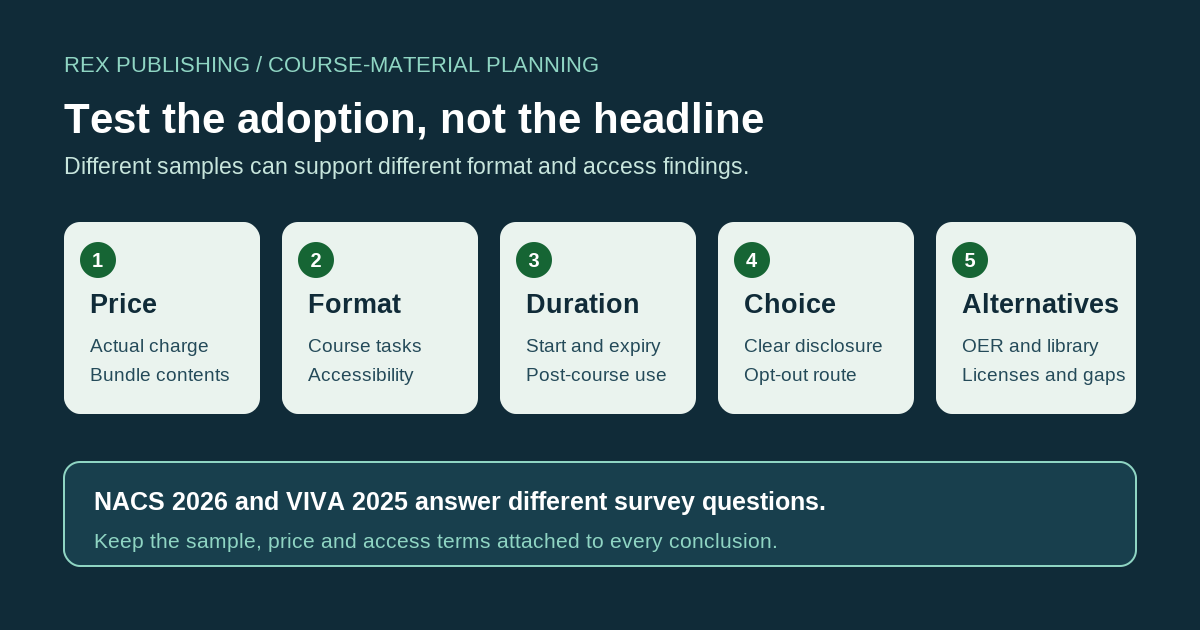
Those findings are not a contest with one winner. The samples, questions and program definitions differ. For education-facing authors and publishing teams, the useful response is a five-check planning record: price, format, access duration, choice and transparency, and open or library alternatives.
Start with the samples, not the headline
NACS says its Student Watch report compiled responses from about 11,177 students at 34 two- and four-year institutions in the United States, Canada and Jamaica. The release reports average required course-material spending of $338 per student for the 2025–26 academic year, lower than any point from 2007 through 2021.
Within that sample, 37% preferred digital and 32% preferred print. NACS also says 54% were satisfied with course-by-course access programs, while 64% of participants considered the program better than other ways of obtaining materials.
VIVA’s study is different in scope. It received 9,853 valid responses from students at 40 of 70 member institutions in Virginia. Seven in ten respondents worried about current-term course-material costs, and one in six faced more than $400 in textbook costs per semester. When asked which format they would prefer if cost were the same, 43% selected print, 29% digital and 22% said it depends.
Neither survey is a national vote on the correct product. NACS is broader geographically but is not a census or a U.S.-only probability estimate. VIVA offers detailed Virginia evidence, not a national estimate. A publishing decision should keep those boundaries attached to every number.
1. Record the price a student will actually face
Use the amount charged for the assigned package, not a general claim that digital is cheaper. Record whether the price covers a book, homework platform, assessment tools or a bundle. Note when the charge appears, whether financial aid can cover it and whether a student can choose a lower-cost route.
The $338 NACS figure is annual average spending across its survey sample. It is not a ceiling for an individual course and does not show what a particular student will pay. VIVA’s results show why that distinction matters: cost pressure remained widespread even though average-spending headlines can point downward.
For each proposed adoption, keep one dated price field and one named owner who will recheck it before the course starts. If the product is sold in several formats, price each route separately.
2. Test format by course and audience
Do not translate digital growth into a digital-only rule. NACS found a larger digital-preference group; VIVA found a larger print-preference group when cost was held equal. NACS’s 2025 Faculty Watch summary adds another distinction: 71% of faculty in its sample had used an ebook in at least one course and 63% had used print, yet more faculty still preferred print to digital.
Use, preference and suitability are different fields. Ask what students need to do with the material: search it, annotate it, retain it after the term, use assistive technology, work offline or move between devices. A single course may need more than one supported format.
Accessibility belongs in this decision before production, not as a late conversion request. Our ebook quality checklist covers a broader file-level QA handoff.
3. State how long access lasts
An access code can open material on the first day and still leave an important question unanswered: when does access end?
VIVA defines the programs it studied as course materials bundled with tuition or fees, commonly delivered digitally for the duration of a course. Its respondents raised concerns about codes expiring and losing access after the course. That does not prove every program has the same terms. It does make duration a required product fact.
Put the start date, end date, offline availability and post-course options in the adoption record. If continued access requires a separate purchase, say so before enrollment or billing. Do not use “first-day access” as a substitute for the full access period.
4. Make price, choice and opt-out terms visible
NACS reports favorable views of course-by-course access among many respondents. VIVA reports that 66% of its respondents were unaware of inclusive-access programs; among students who were aware of or had used them, fewer than a third knew about opt-out options. VIVA’s open-ended responses also raised concerns about unclear charges, limited flexibility and non-functioning codes.
The program types and survey questions are not identical, so the percentages should not be averaged. They point to the same operational check: a student should be able to see what is included, what it costs, how long it lasts, whether opting out is allowed, how to do it and what alternative will still satisfy the course.
Test that explanation with someone who did not help design the program. If they cannot identify the price and choices quickly, the disclosure needs work.
5. Keep OER and library routes in the comparison
NACS says 47% of faculty in its Faculty Watch sample reported using open educational resources. It also says 62% would be unlikely to continue an adoption when the price exceeded what they considered reasonable for students.
That is a reason to compare the commercial package with available OER, library-licensed material and instructor-created resources. It is not a direction to replace every paid work. Record what each alternative covers, its license, accessibility, maintenance needs and whether it includes the instructional support the course requires.
The comparison can also expose rights and metadata work early. A library license may have user or territory limits. An OER adaptation may require attribution and change tracking. A digital product may need a distinct identifier when its accessibility features or product form differ; our accessible-edition identifier guide addresses that separate question.
Keep AI in its proper place
NACS says around a third of students in its sample used AI tools at least weekly, while more than 80% thought over-reliance could hurt academic performance. Faculty Watch reports uncertainty as well: only 8% of respondents strongly agreed that they could spot AI-written student work.
Those findings do not show that an AI feature improves a course material, reduces its price or makes a digital format preferable. Treat AI as a separate editorial and support decision. Record what the feature does, what material it processes, what rights permit that use, how its output is reviewed and whether students can complete required work without it.
Use one adoption record
The following is a Rex editorial workflow, not a form issued by NACS or VIVA.
| Check | Record before adoption | Do not assume |
|---|---|---|
| Price | Student charge, bundle contents, payment timing and cheaper routes | A lower market average settles this course |
| Format | Course tasks, supported formats, offline use and accessibility | Use equals preference |
| Duration | Start, expiry, post-course access and purchase options | First-day delivery means lasting access |
| Choice | Disclosure, opt-out steps, deadline and workable alternative | Enrollment proves informed acceptance |
| Alternatives | OER, library and instructor-created options, with licenses and gaps | Every alternative is complete or maintenance-free |
| AI | Purpose, data and rights boundaries, review and non-AI route | An AI feature answers the five checks above |
These sources were checked on November 24, 2026. The public NACS pages summarize paid reports and come from a campus-retailing trade association. The VIVA report supplies an independent, openly available Virginia evidence bucket. Their differences are the point: product planning needs a named audience and a documented access model. “Students prefer digital” or “access programs work” is too broad to make the decision for you.