As of Monday, August 17, 2026, the Association of American Literary Agents has published its revised canon of ethics, but the new version does not take effect until September 1, 2026. That timing matters because some authors will read the change too loosely and some will overcorrect in the other direction.
The practical reading is narrower. AALA has not turned agency-linked paid services into a general trust signal, and it has not made its membership rules into law for the whole literary-agent business. What it has done is rewrite its ethics framework so authors, clients, and agencies have a more explicit set of disclosure and non-coercion rules around editorial work, referrals, and other paid services such as marketing, promotion, or web design.
For Rex readers, the value is operational. If an agent or agency offers paid help alongside representation, what should an author or rights-facing team check before any money changes hands?
Start with the dates before you argue about the policy
The old AALA canon was effective April 29, 2022. AALA's comparison note, published on July 2, 2026 and later updated on July 15, 2026, says the 2026 rewrite responds to a changed market shaped by publisher consolidation, new publishing models, digital and social media work, mobile technology, and AI-era pressure on authors and agents.
That does not mean every new business practice is now ethically clean. It means AALA decided its earlier text no longer described the real scope of work many agencies and creators now encounter. The revised canon is the association's attempt to write clearer guardrails around that wider scope.
What did not change
Two points remain especially important.
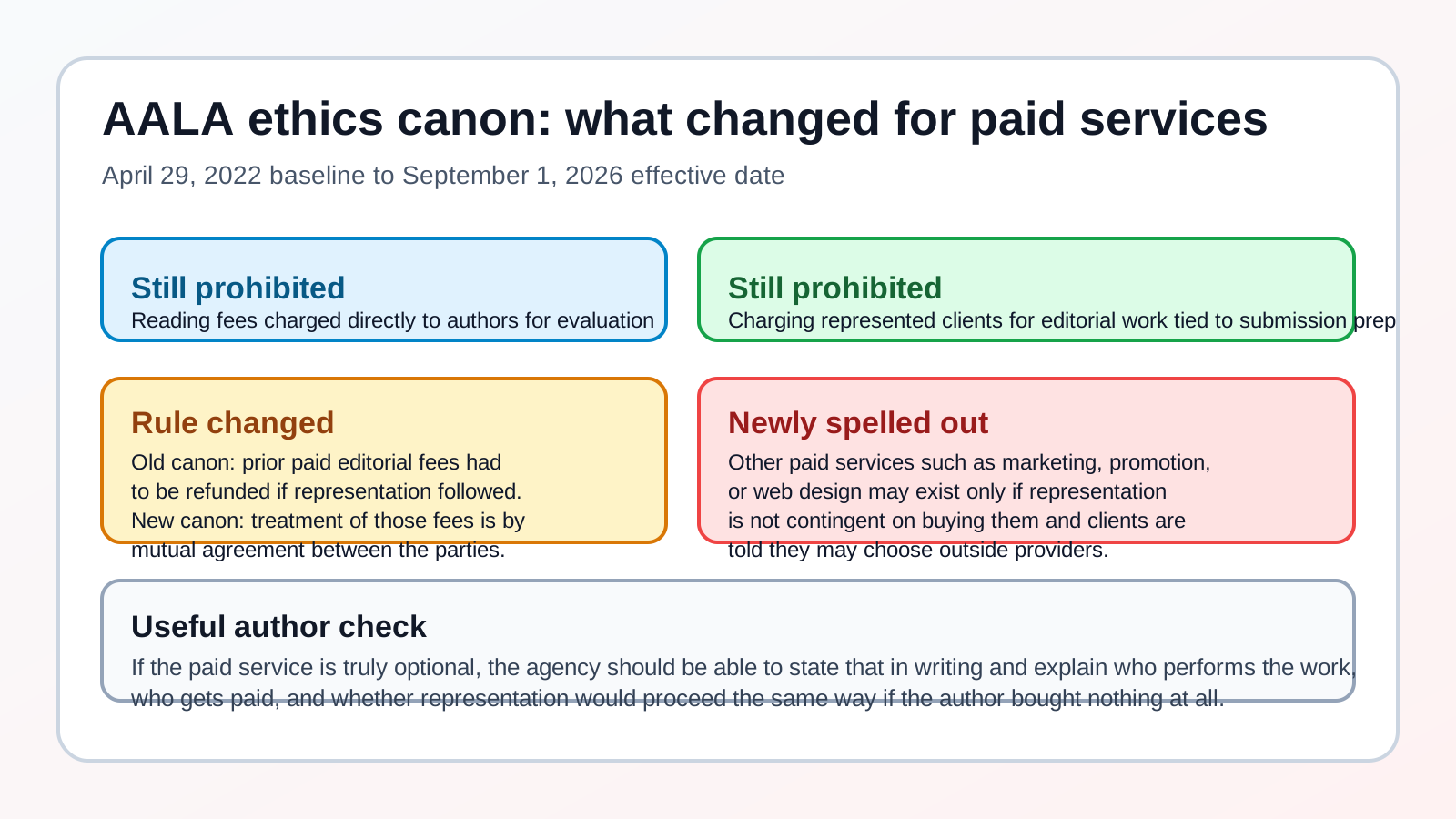
- No reading fees. AALA still says members may not accept payment directly from authors for evaluating literary work for possible representation. The conference and school exception still exists only where the payment comes from the organizing entity, not from the writer.
- No charging clients for submission-prep editorial work. If an author is already a client, the member agent still may not charge that client for editorial services tied to submitting the work to publishers.
Those two continuities matter because they cut through the noisiest reaction. The revised canon is not a green light for reading fees, and it is not permission for an agent to bill a represented client for normal editorial shaping before submission.
What changed in a way authors should notice
The biggest shift is not that paid services exist. Those already existed around the market. The shift is that the revised canon now spells out how some of them may be offered within an AALA-governed ethics framework.
Under the archived 2022 canon, if a non-client paid a member for editorial services and that member later offered representation, the member had to return those prior editorial payments in full. Under the revised 2026 canon, treatment of those earlier payments is now left to mutual agreement between the parties.
The revised canon also adds a new section allowing agencies to offer other paid client services, including work such as marketing, promotion, and web design. But the allowance comes with two clear limits: representation cannot depend on buying those services, and clients must be told in advance that they may use outside providers of their own choosing.
For non-clients, the revised canon says members may offer editorial or non-editorial services only if they clearly state in writing that the service does not imply representation. It also preserves a critical anti-abuse rule: if a writer approaches an agent only for representation, the agent may not respond by steering that writer into paid services from the agent or anyone financially associated with the agency.
The useful question is not “is this allowed?”
Authors usually need a sharper filter than that. A better question is: what disclosures, choices, and paper trail should exist if this arrangement is truly optional and ethically separated from representation?
Before paying for any agency-linked service, ask for five things in plain written form:
- Status clarity. Are you already a represented client, a prospective client, or simply buying a standalone service with no representation attached?
- Service clarity. What exactly is being purchased: editorial feedback, marketing support, website work, platform help, submission preparation, or something else?
- Provider clarity. Who will actually do the work, and what is that person's financial or organizational relationship to the agent or agency?
- Choice clarity. Are you being told explicitly that you can use a third party of your own choosing instead?
- Representation clarity. Is anyone implying, directly or indirectly, that paying for the service improves your chance of getting or keeping representation?
If those questions produce evasive answers, the ethics problem is not abstract. It is already operational.
What rights-facing teams should take from this
Small presses, translators, and author-services teams sometimes encounter these agency-side service bundles from the outside rather than as the paying party. The revised canon is still useful to them because it sharpens due-diligence language. If an author arrives with agency-linked editorial, marketing, or platform work already in motion, ask what role that service played and whether it was optional, disclosed, and separate from representation.
That is also why this should not be treated as legal advice. AALA's canon is an association ethics framework for its members. It is not a statute, and it does not govern every agent, agency, consultant, or hybrid service business in the market. But it can still help authors identify when a sales pitch sounds cleaner than the actual structure behind it.
If you are reviewing related paperwork, our translation contracts baseline guide is a useful companion for rights clauses and deal discipline. If the problem is broader workflow risk rather than one clause, contact Rex Publishing.
The practical takeaway
AALA's revised canon, effective September 1, 2026, does not tell authors to relax about paid services. It tells them where to look harder.
The no-reading-fees rule remains. Charging clients for submission-prep editorial work remains prohibited. What changed is that some other paid services can now sit alongside representation inside AALA's framework, but only if they are handled with disclosure, real client choice, and clear separation from the representation decision itself.
For authors, that means the safest response is neither outrage nor blind trust. It is documentation. Ask whether the service is optional, who benefits financially, who performs the work, and whether representation would proceed on the same terms if you declined to buy anything at all.