Updated October 30, 2026: pricing-boundary correction and refreshed budgeting guidance. Originally published August 14, 2026.
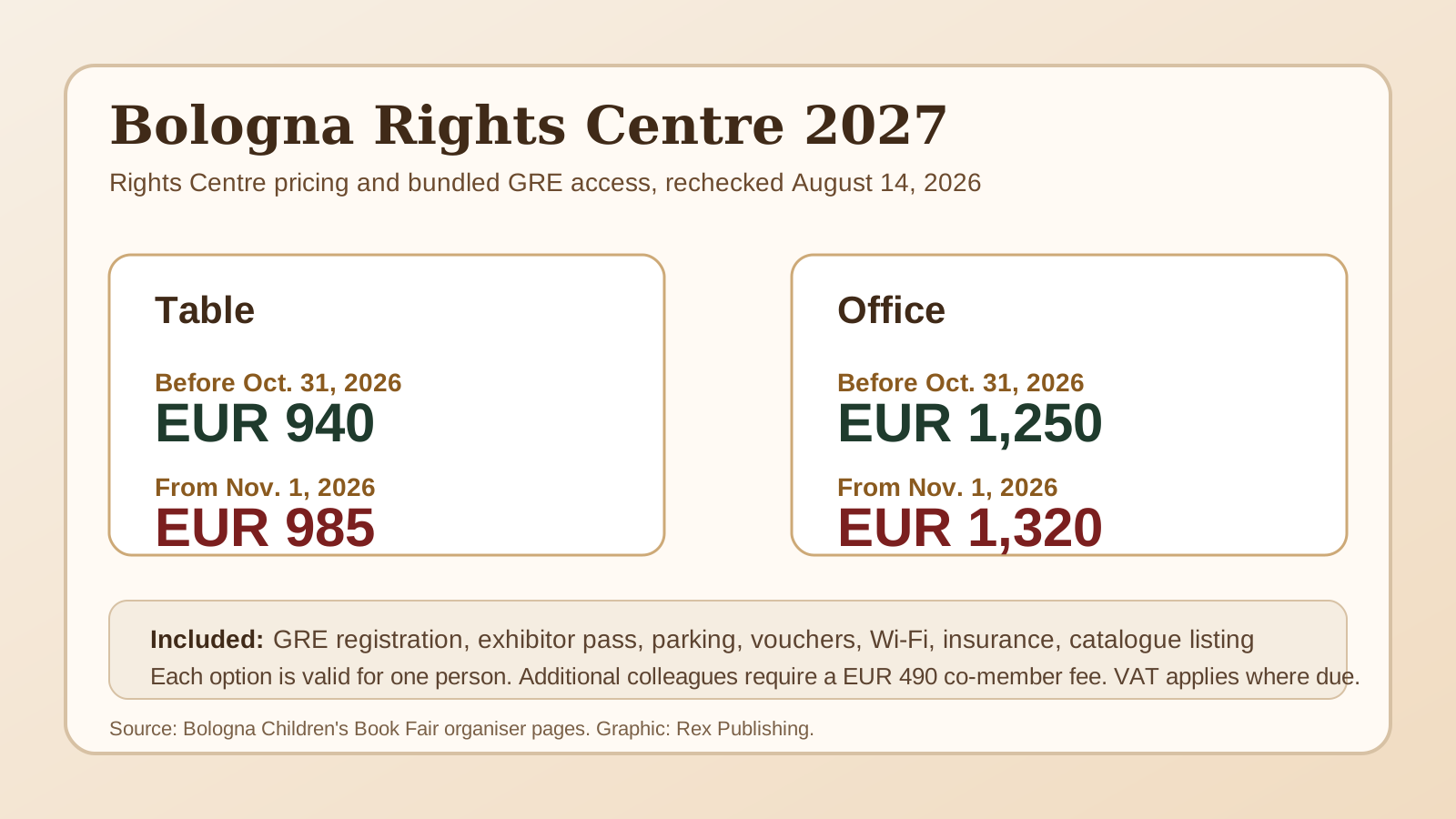
Bologna Rights Centre planning starts with two questions: how much meeting space does your team need, and who will maintain its rights catalogue after the fair? The organiser's 2027 participation page, checked on October 30, lists tables at EUR 940 before October 31, 2026, and EUR 985 from November 1; offices are EUR 1,250 and EUR 1,320 on the same schedule. VAT is extra where due.
The wording does not settle which rate applies on October 31. Confirm that boundary and availability with the organiser before relying on a lower-rate booking. This guide previously called October 31 the last day before the increase; that unsupported assertion has been removed.
The participation fee includes GRE registration, a fair exhibitor pass, parking, vouchers, Wi-Fi, insurance and catalogue inclusion. For a small rights team, those bundled services matter only if they support work the team is ready to do.
The first planning split is table versus office, not yes versus no
The Rights Centre page says the space is open to both children's and adult agents, and that exhibiting publishers across BCBF and BolognaBookPlus can buy tables or offices there. That is a narrower and more useful framing than the general claim that "Bologna is important for rights."
For many small agencies, scouts, and rights-facing presses, the realistic choice is not between taking a large stand somewhere else and buying a Bologna office here. It is between a lower-cost table that gives one person a dedicated meeting base and a higher-cost office that makes sense only if privacy, heavier scheduling, or repeated partner meetings justify the jump. Bologna also says each option is valid for one person and that additional colleagues require a 490-euro co-member fee. That extra line matters because a cheap-looking base price can stop looking cheap once multiple staff are added.
GRE is the part that can make the package more than four fair days
Bologna's Global Rights Exchange page describes a year-round platform for rights, distribution and licensing. Catalogue uploads, search filters, chat and video meetings can support partner outreach. The useful budgeting question is whether your team has material and staff time to use it.
That year-round layer is the real business case behind the Rights Centre pricing. BolognaBookPlus's Rights at BolognaBookPlus page says GRE helps exhibitors and visitors continue to showcase, discover, and trade rights across the world, with support that extends across the year rather than only during fair week. If a team will actually load titles, keep rights information current, and use the platform to line up meetings, the fee looks different from a short-lived floor cost. If it will not, then the package becomes much harder to defend.
Do not confuse bundled access with guaranteed deal flow
The organiser describes GRE's features, not a forecast of your results. The pages do not say that paying for a table or office guarantees quality meetings, faster rights sales, or stronger catalogue discovery by itself. The cleaner reading is operational. Bologna is offering a dedicated meeting space plus a rights-platform workflow. Teams still have to do the hard part: clear rights metadata, usable sample material, appointment discipline, and follow-up.
That is especially important for smaller teams tempted to buy access first and work out the catalogue later. GRE can support a rights process. It does not replace one. If the titles are not ready to present, if territorial rights are fuzzy, or if nobody owns outbound follow-up, a lower participation rate can still be wasted money.
Budget for readiness, not a presumed last day
For an author or rights holder, the sensible test is whether a dedicated base improves an existing meeting plan. A thin list, uncertain rights status or limited follow-up capacity can make even the lower price poor value. A prepared team can compare the full participation cost with the meetings it actually expects to arrange, without treating the published schedule as a promise of inventory or acceptance.
What to check before committing a budget
- Choose the space honestly. A table works if one person mainly needs a reliable meeting base. An office is harder to justify unless privacy or heavier scheduling is real.
- Confirm the applicable rate and count heads. Ask the organiser about October 31 treatment, availability and VAT before paying. Bologna says extra colleagues trigger a 490-euro co-member fee, so the real budget is not only the headline table or office price.
- Decide whether GRE will be used year-round. The platform value appears only if the team will maintain listings, search actively, and schedule follow-up meetings.
- Separate workflow value from fair mythology. Buy the package for meetings and rights operations, not because Bologna feels mandatory in the abstract.
- Freeze the catalogue prep before you book. Bundled access is more valuable when title material, rights status, and outreach ownership are already clear.
For related Rex coverage, see our Frankfurt workstation guide, our Frankfurt rights-meeting guide, and our translation-rights checklist. If you need help turning fair access, rights prep, and outbound follow-up into a cleaner international publishing plan, contact Rex Publishing.
The practical takeaway is to price a meeting base and a manageable GRE workflow together. Prepare the catalogue and assign follow-up ownership first; then confirm the applicable terms with the organiser. A cheaper space does not repair an unready rights pitch.