Format adaptation · Published and updated
Before commissioning a digital adaptation, decide what the reader will actually do. Listening to an authored story, choosing a route through it, exploring its world and contributing new material create different editorial jobs. Calling all four an “interactive project” hides decisions that rights holders and production partners need to make explicitly.
The Digital Narratives Observatory, promoted by Associazione Literacy Italia and Bologna Children’s Book Fair, provides a useful vocabulary. Its 2026 report combines a publisher survey, research discussion and analysis of crossmedia work for children and young people. It is a planning resource, not evidence that any one format will succeed commercially.
Four modes, four different questions
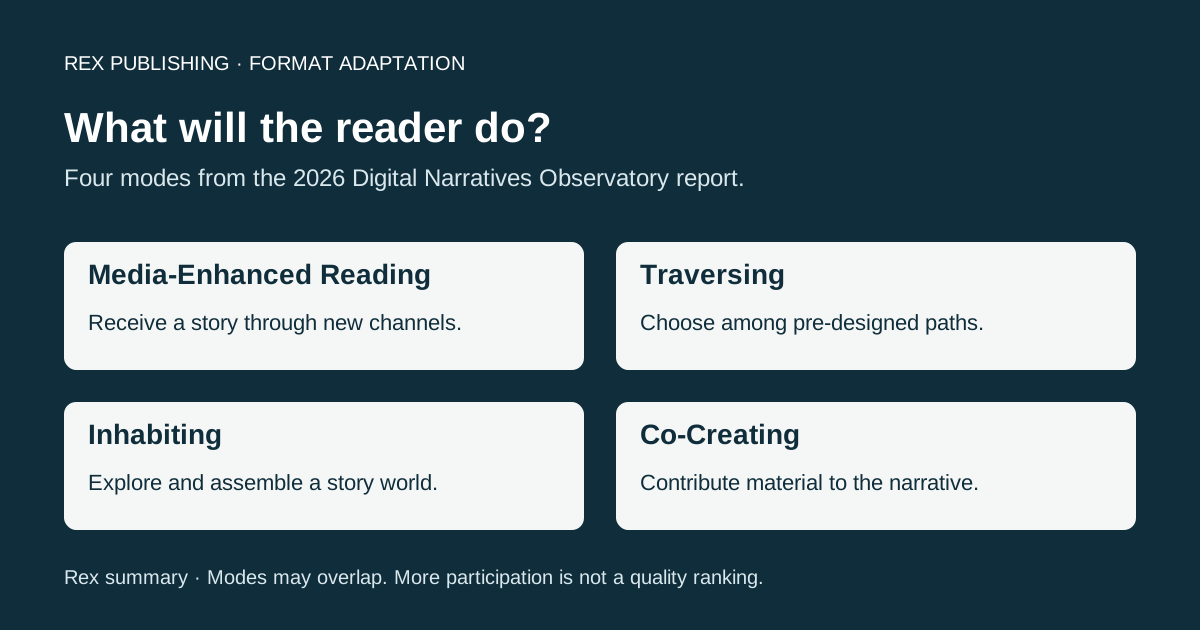
Pages 23–26 of the report describe four modes of narrative engagement. The source distinctions are summarized below; the final column is Rex editorial guidance for preparing an adaptation brief.
| Observatory mode | Reader’s role | Question to settle in your brief |
|---|---|---|
| Media-Enhanced Reading | Receives an authored story through additional sensory channels | What does sound, animation or another presentation layer add to this story? |
| Traversing | Chooses among pre-designed paths | Who designs and checks each route, including its ending? |
| Inhabiting | Explores a story world and assembles meaning spatially | How will readers find essential narrative material without a fixed sequence? |
| Co-Creating | Contributes or generates material within the narrative | Who reviews contributions, sets participation conditions and maintains the result? |
These are not quality rankings. The report says the modes are neither a hierarchy nor mutually exclusive; a work can span several. More participation is not automatically a better adaptation. Choose the relationship that serves the story and the intended reader.
Read the survey within its limits
The Observatory surveyed Bologna exhibitors in February–March 2026 and gathered 121 responses from children’s publishers. Its report explicitly says the survey is not statistically representative of the global publishing industry. Europe accounts for 62.8% of respondents, so even its international coverage should not be mistaken for an evenly distributed market sample.
There is a small source inconsistency worth keeping out of a false-precision headline: the fair page and report prose give Asia’s share as 11.6%, while Table 5.1 shows 10.8%. The overall sample and European share are consistent. That discrepancy does not change the four-mode framework, but the unresolved regional figure should not drive a market comparison.
The survey offers useful questions about readiness. Figure 5.3 reports uncertainty about demand at 47.1% and high production/development costs at 43.8%. These are shares of this sample, with multiple responses allowed—not estimates for all publishers. They support asking how a proposed project will be tested and funded; they do not establish its likely return.
Keep the adaptation brief operational
Our suggested next step is a short brief that names the intended mode, the reader’s main action and the evidence needed before a larger commission. For a branching narrative, that might mean a small prototype with an agreed route-checking process. For a participatory project, it means making contribution review and ongoing editorial responsibility visible before treating participation as a feature ready to launch.
Keep rights scope separate from a technology label. “App” says little about whether the project adds audio, rearranges the plot or invites new authorship. Use our translation-rights checklist for ownership and prior-grant preparation, then describe the actual adaptation in the brief. The four modes do not grant permissions or settle contract interpretation.
Decide what a prototype must demonstrate
Write one sentence describing what the reader gains, then identify what would count as evidence that the format delivers it. A prototype should answer that question before the team expands platform, budget or licensing ambitions. This is the Observatory’s practical value for a small publisher: a clearer discussion about the reading experience before an exciting format becomes an undefined production commitment.
Sources checked October 21, 2026, including report pages 12, 16 and 23–29. The April 15–16, 2026 launch sessions are past events; this guide makes no attendance, product-testing or educational-outcome claim.