Translation-rights royalty statements usually become painful long before anyone says so plainly. Authors and agents cannot reconcile what was sold. Rights teams spend time translating one publisher layout after another. Basic questions about territory, reserves, tax treatment, or sublicense income get buried in documents that technically report money but do not make the workflow easy to verify.
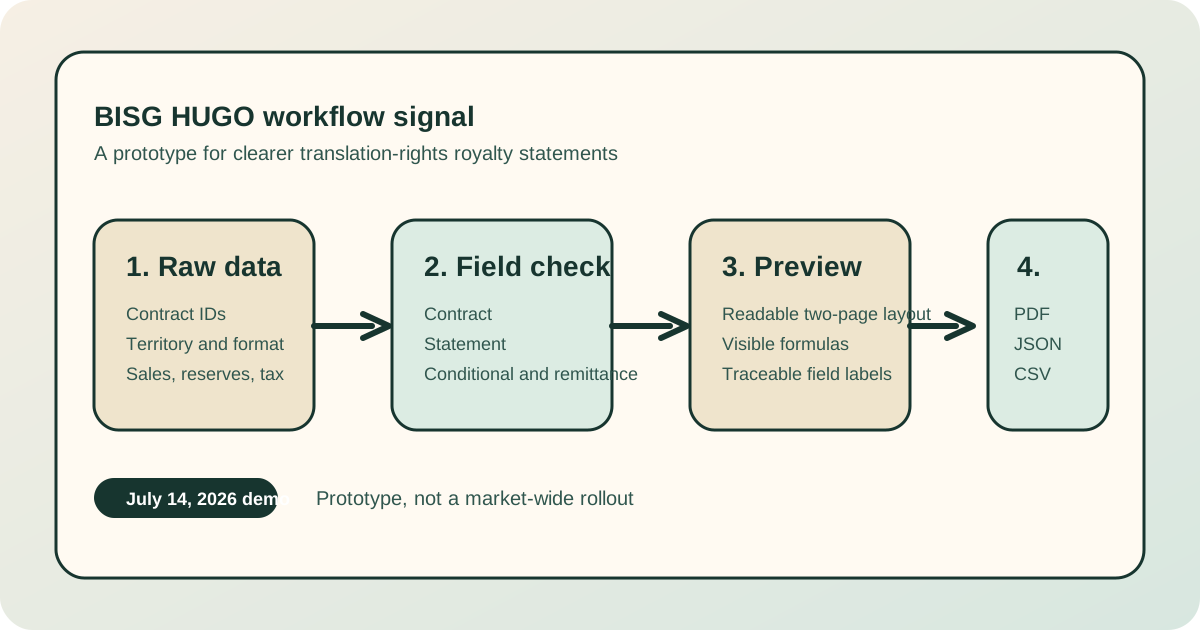
That is why BISG's scheduled Tuesday, July 14, 2026 HUGO prototype session is worth attention. The event page is unusually concrete. BISG says the Translation Rights Royalty Statement Standard is meant to identify the information that should be present in a good translation-rights statement, and says the HUGO prototype turns that logic into a web-based tool with manual entry, a live two-page preview, completeness checks, and export to PDF, JSON, or CSV.
The important point for Rex readers is not that BISG has unveiled a finished industry platform. It has not. The important point is that BISG is showing what a standards-aligned reporting workflow could look like in practice.
The real problem is usually not the total, it is the missing context
BISG's event page makes the standard's purpose clear. It is not there to impose one visual layout on everyone. It is there to define the information a usable translation-rights statement should carry: who the parties are, which contract and work the statement covers, what formats sold, how royalties were calculated, what reserves or balances affect payment, and what remittance or tax details are needed to reconcile the final amount.
That is a better framing than the usual "royalty statements are confusing" complaint because it turns confusion into a checklist problem. If a statement omits advance information, hides sales territory, skips reserve activity, or leaves payment-matching details vague, the problem is no longer just style. It is workflow quality.
- For authors and translators, missing fields make it harder to judge whether a statement is complete enough to trust.
- For agents and rights holders, inconsistent layouts make cross-publisher comparison slower and more error-prone.
- For publishers, incomplete reporting creates avoidable email loops, reconciliation friction, and audit anxiety.
BISG is describing four field groups, not one vague standard
The useful part of the HUGO page is how specific it gets. BISG divides the standard into practical categories rather than abstract metadata talk.
- Contract-related fields include the licensee, payer, licensor, contract identifiers, contributor names, original and translated titles, language, sales territory, and advance.
- Statement-specific fields include the reporting period, prior balance, units sold, ISBNs, formats, publication dates, list prices, royalty rates, royalty basis, earnings, reserves, closing balance, and payment due.
- Conditional fields cover sublicense cases such as sublicensee, sublicense type, income received, licensor share, and amount due.
- Remittance fields cover payment-matching details, commissions, VAT or tax identifiers, withholding treatment, and final remitted amount.
That level of structure is what makes the story publishable. Rex readers do not need to attend the meeting to understand the operational lesson. A better statement workflow is one that makes these categories visible instead of forcing recipients to infer them from custom wording or spreadsheet archaeology.
HUGO matters as a prototype because it shows one implementation path
BISG says HUGO allows manual entry, a live two-page statement preview, completeness validation against BISG field categories, and export as PDF, JSON, or CSV. It also says field labels indicate whether data is required, recommended, conditional, or remittance-related, and that optional BISG field identifiers can make the output traceable back to the standard.
That does not prove the market is about to converge on one tool. It does show something more practical: compliance does not have to mean replacing a whole accounting system first. A standards-aligned workflow could begin as a checklist, a readable export layer, or a validation step between internal accounting data and the outward-facing statement.
That is exactly the kind of middle path many small and midsize publishing operations need. Full system replacement is expensive. But continuing to send opaque statements because the internal system is old is not much of a strategy either.
BISG's own explanation of the prototype is a warning about real-world statement gaps
The event page says Rights Committee member Sebastian Ritscher built HUGO after comparing a real publisher statement against the BISG standard. BISG says that exercise exposed recurring omissions or obscurities around advance amount, sales territory, list price, reserve activity, sublicense income, tax treatment, and payment reconciliation.
That list is more useful than generic rhetoric about transparency because it names the fields that often break trust. If a rights recipient cannot tell which territory the line covers, whether reserves changed, or how the net remittance was reached, "we sent the statement" is not the same as "we sent a statement that can be verified efficiently."
This is part of a broader BISG rights push, not a one-off demo
On BISG's Rights Committee page, the organization says accurate rights-information transmission can grow revenue, reduce transaction costs, and avoid costly errors. Its 2026 Rights Committee Charter goes further, listing industry-wide adoption of the Translation Rights Royalty Statement Standard among the committee's 2026 deliverables.
That matters because it keeps this article honest. HUGO is not just a clever side project on an event page. It sits inside a formal committee effort to make rights information more standardized and more usable. The inference here is mine, but it is a cautious one: BISG appears to be testing not only the standard itself, but also what adoption might look like when the standard is translated into a readable tool and export workflow.
What Rex readers should actually do with this
The practical takeaway is not "wait for HUGO." It is "use the HUGO description as a diagnostic for your current reporting workflow."
- Check whether your outgoing translation-rights statements make contract, statement, conditional, and remittance data easy to find.
- Flag recurring blind spots such as advance handling, territories, reserve activity, sublicense income, and tax treatment.
- Separate internal accounting complexity from the external need for a readable and reconcilable statement.
- Test whether your current process could export cleaner reporting without forcing a full finance-system migration.
- Treat the July 14, 2026 BISG session as a workflow signal, not as proof that one prototype has become an industry default.
If your team works across territories or with multiple licensors, that discipline matters even more. Standardized field coverage is not glamorous, but it is exactly the kind of operational hygiene that reduces pointless rights friction.
For related Rex coverage, see our translation contracts baseline guide, our copyright recordation guide, and our ONIX workflow guide. If you need help making rights and royalty operations easier to audit across markets, contact Rex Publishing.