EPUB production workflow · Published and updated
EPUB review still produces too many screenshots, copied passages and email threads. A typo may arrive in one document, a missing image description in another, and a translator’s query in a message with no durable link to the passage it concerns.
The W3C’s draft EPUB Annotations 1.0 points toward a cleaner handoff. It defines a shared format for notes, highlights and bookmarks, including an AnnotationSet that can travel as a detached file or inside an EPUB package. The useful idea for a publishing team is straightforward: feedback can remain attached to a target in the book instead of being flattened into a screenshot.
This is still standards work, not a feature you can assume every reading system or editing tool supports.
Start with the production handoff
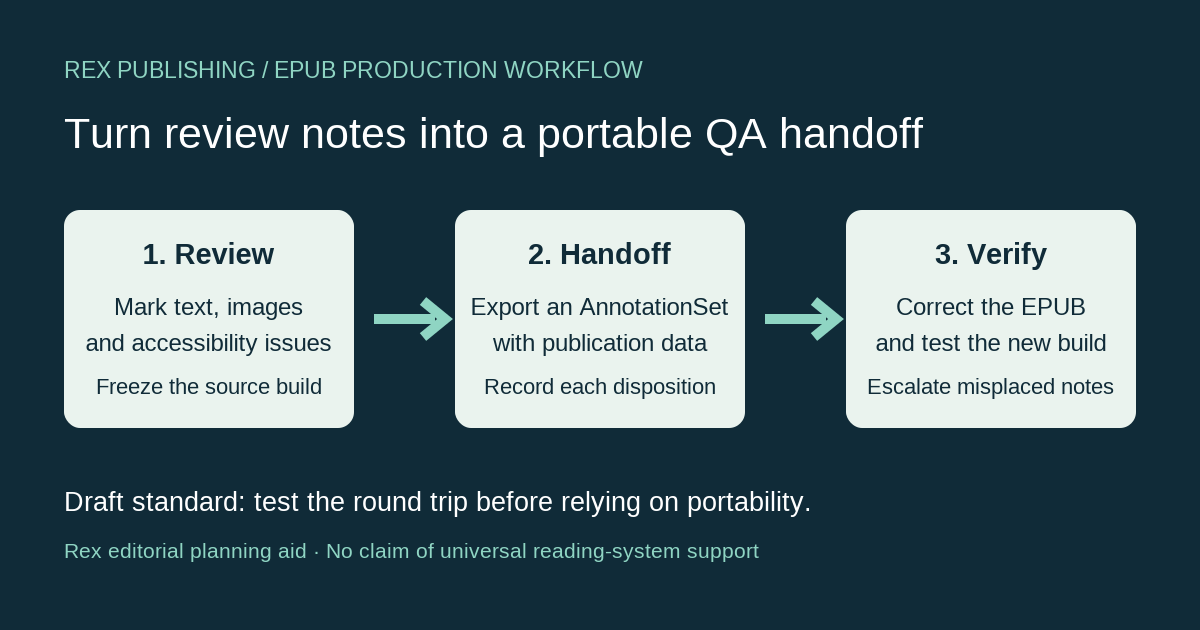
The W3C’s use-cases note gives a concrete publishing example. A copy editor opens an EPUB, marks typos and images with missing descriptions, exports the annotations, and sends that file to the EPUB creator. The creator imports the set into a compatible editing tool, reviews the issues and corrects the book.
That model can support several review lanes:
- copy editing tied to the exact text being corrected;
- accessibility QA tied to an image or other publication resource;
- translator queries that retain language, direction and location data;
- machine-generated reports that a human can filter and resolve;
- a verification pass after the corrected EPUB is rebuilt.
The specification groups annotations for exchange and associates the set with publication information. That is a better starting point than treating each note as a loose comment. It does not, by itself, create an editorial workflow or decide who may close an issue.
Keep the file and the decision record separate
An annotation can identify a problem and carry a proposed correction. The production team still needs a small decision record around it. The following is Rex editorial guidance, not a W3C template.
| Field | What to record | Why it matters |
|---|---|---|
| Source EPUB | Identifier, file hash or controlled build label | Prevents notes from being applied to the wrong revision |
| Review lane | Copy, translation, accessibility, metadata or automated check | Routes the issue to the right owner |
| Annotation set | Export name, generation time and reviewer identity policy | Keeps the handoff traceable without collecting unnecessary personal data |
| Disposition | Accepted, rejected, needs evidence or superseded | Separates a comment from an approved change |
| Verification | Corrected build and result of the second check | Shows that the fix reached the deliverable |
Do not make annotation color do the work of status. The draft treats colors as labels that reading systems map to actual display values. Use an explicit disposition field in your own tracker.
Plan for revision mismatch
Portable comments are useful only if the recipient can connect them to the intended book and location. The draft requires publication information when annotations are shared as a detached set. Its use cases also describe annotations surviving changes such as added text or a modified spine.
That is a design goal, not a guarantee that a note will land correctly after every rewrite. A production team should still freeze the reviewed EPUB, identify the build, and test re-import after meaningful structural changes. If an annotation cannot be placed confidently, flag it for manual review rather than attaching it to the nearest plausible passage.
This matters in multilingual work. A translated edition is not merely a newer file of the source-language EPUB. Its text, structure and identifiers may differ. Keep each annotation set connected to the edition and build it actually reviews.
Treat exported notes as sensitive production data
The October 15 Working Draft contains a substantial privacy and security section. W3C notes that reading choices, selected passages and the content of notes can reveal personal or confidential information. An export may also carry timestamps, creator details and selector structures that a reviewer did not expect to share.
Before exchanging a set:
- export only the fields needed for the review;
- avoid real names, email addresses and persistent identifiers by default;
- inspect whether timestamps need full precision;
- warn reviewers before personal notes are embedded in an EPUB;
- transmit review files through an approved secure channel;
- treat imported annotation data as untrusted input.
Plain-text notes do not remove the security problem. The draft tells reading systems not to interpret markup in annotation bodies as executable content and to handle imported data defensively.
Do not buy a workflow on draft status alone
The current EPUB Annotations document is a W3C Working Draft dated October 15, 2026. W3C says it may change and should be cited as work in progress. The related use-cases document is a Working Group Note, while the annotation vocabulary remains a draft note. The latest EPUB 3.4 document advanced to Candidate Recommendation Draft on November 25, but it is also not a final Recommendation.
The annotation specification does not define how a reading system creates, stores or synchronizes annotations. Cross-device cloud synchronization is explicitly outside its current scope. Do not promise live collaboration, universal import, or reliable cross-app portability because a tool says it supports “EPUB notes.”
Instead, ask a vendor or internal tool owner to demonstrate a bounded round trip:
- create notes against text and an image in a controlled EPUB;
- export the annotation set and inspect its publication metadata;
- import it into the intended production tool;
- correct the EPUB and generate a new build;
- re-import or verify the annotations against that build;
- document what failed, including unsupported payloads or misplaced targets.
If the round trip does not work, keep the existing issue tracker. A standards-shaped export is useful only when the production chain can read it accurately.
Use the draft as a readiness checklist
The immediate value is not a universal annotation service. It is a clearer set of questions for the next EPUB review workflow: Can feedback identify its source build? Can another tool import it? Does it survive a revision? Can a reviewer see what personal data will leave the device? Can the team record resolution separately from the note itself?
For the wider format baseline, use our EPUB 3.3 guide. For language and text-to-speech handoffs, see the multilingual EPUB workflow. Authors and rights holders planning a conversion can also start with our Word-to-EPUB adaptation guide.
The W3C sources in this article were checked on November 27, 2026. No commercial reading system was tested, and this article does not claim market-wide support.